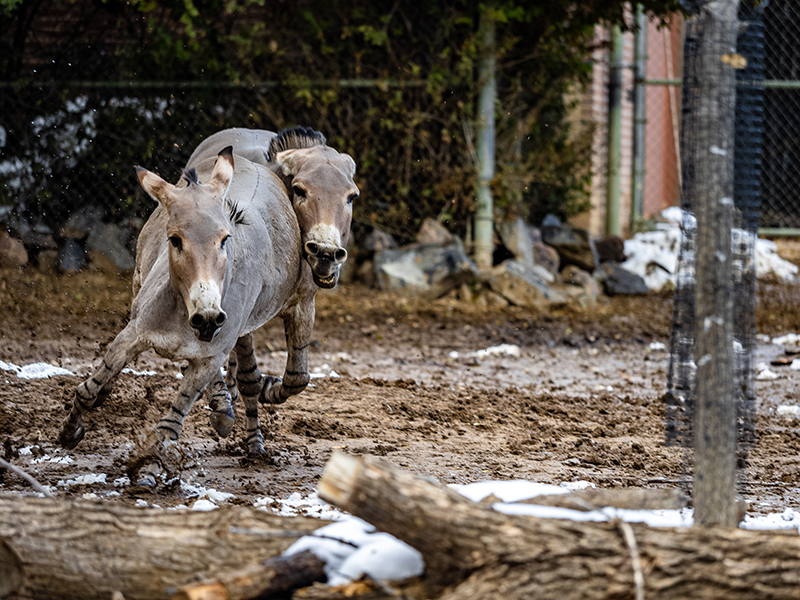
Olympus is doing something really cool right now. They’re putting on a program that they call Test and Wow, where for literally zero cost, you can try out their micro four thirds system, anything from the entry level stuff to the top of the line E-M1x. Friend of the blog ZooPhotoTips loves his Olympus kit, and it was something with which I’d had zero experience, so I invested the zero dollars, set up an appointment with Mike’s Camera Denver, and gave a shot to their top of the line body and pro tele-zoom.
I took the kit to a few places: the Denver Zoo, the Rocky Mountain Arsenal National Wildlife Refuge, and the Pueblo Zoo. The shot above is from Denver, and it’s what sold me on the attraction ZooPhotoTips has for the system. The autofocus is incredible, the frame rate is insane, and the 40-120 is a beautiful, beautiful lens. The action our Wild Asses were putting on was the perfect arena in which the E-M1x could show off.
And I said on Instagram that day that if I were to ever add a 4/3rds camera to my kit, it’d be because of the shot above.
Unfortunately, it was the rest of the shots that showed me that I probably wouldn’t do that. The format excels in the telephoto range, shooting action, and in bright daylight. And while there’s a little bit of that in the zootography I do, it’s not everything. I was actually confident enough in the system after that first test that I brought it as my primary camera for the trip to Pueblo the next day, and that was something I kind of ended up regretting.
When trying to shoot through mesh or habitat fences, the crop factor of the 4/3rds sensor makes it much more difficult to blur out those unwanted elements. When shooting in less than ideal lighting, the sensor noise gets bad fast. I have a shot on the front page of the website taken with the z6 at ISO 40,000. The E-M1x made me uncomfortable above 1000. I did get some ISO 4000, 5000 shots that were usable, and I believe that with more experience in the system I could make that happen more often, but my old d700 *LIVED* at ISO 3200.
I’ve said before that I can live with more image noise than most. I don’t mind an image that looks like it was shot on Superia 800 instead of a Hasselblad digital back. But those troubles with blurring out background and foregrounds is a killer. The Pueblo Zoo shots on the front of my website aren’t likely to be there for long; I fell in love with the zoo, and fully intend to go back soon with the Tamron 150-600 and the Nikkor 400/2.8 and get some shots that I really truly love.
This is by no means a scientific review, and I have no intent of disparaging Olympus or those that use their products. The camera was an absolute joy to shoot with. When I was walking around Denver with it, the z6 and 400/2.8 felt like a cast iron ball and chain draped over my shoulder. I really do see the attraction. I’m actually a little shocked the system isn’t used MORE often by daylight sports photographers and birders who focus on birds in flight. But for what I do? That small sensor is just too big a handicap 95% of the time. The biggest thing it sold me on – and I know this wasn’t Olympus’s intent- was the Sigma 120-300/2.8, because the Olympus 40-150 (80-300/2.8 full frame equivalent) was an incredibly good focal length for zoo work.
But honestly, the biggest positive I can say? It’s that Olympus is willing to put the gear out there for free test drives. That willingness to expose people to their products, to stand behind them, that gives me a massively good impression of them as a company. And I can really say that if I’m ever travelling somewhere where I can justify dropping some weight at the expense of some photographic versatility, I’d rent the E-M1x in a heartbeat.
 The Zootographer